Foundation Time-Series Model Research Agenda
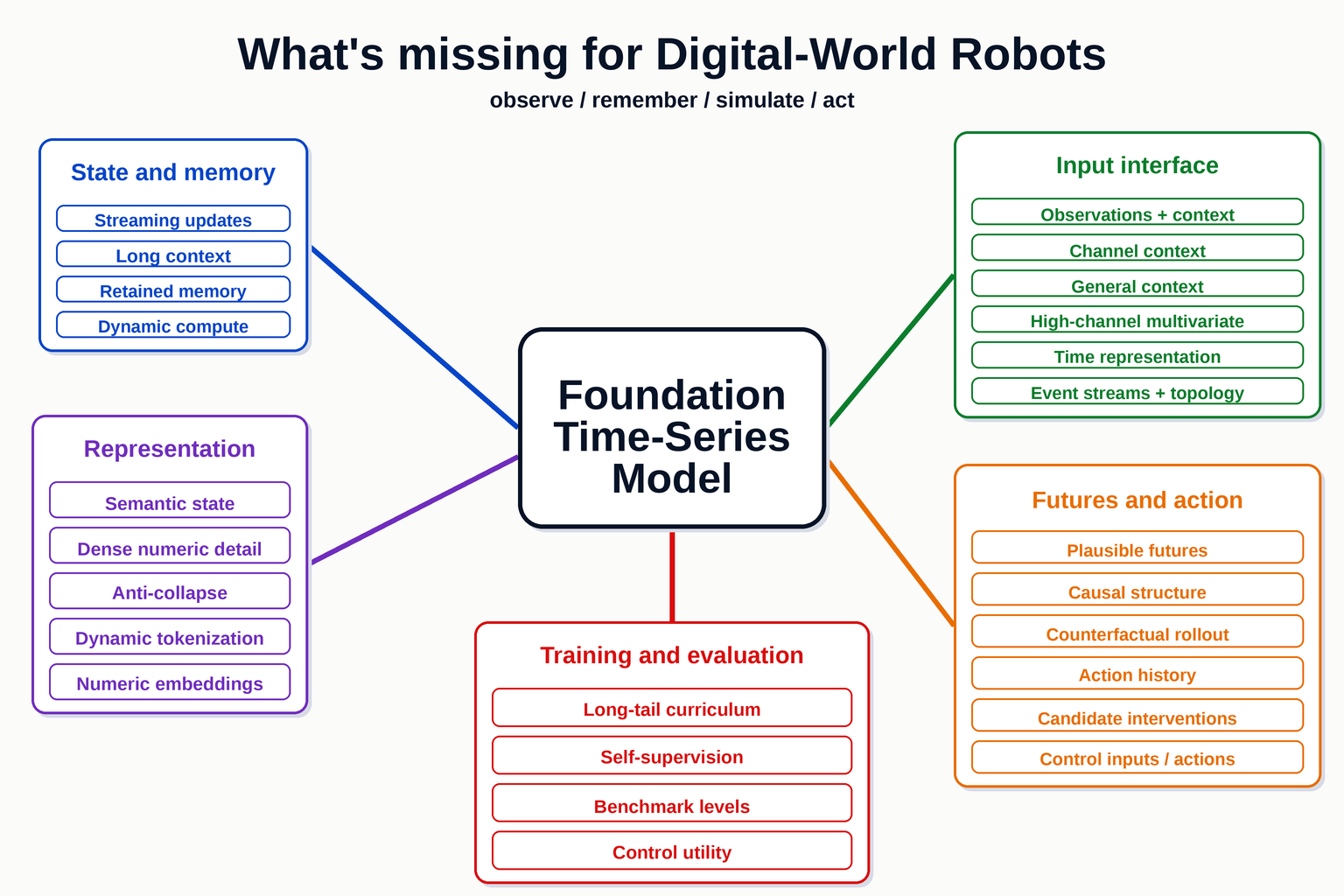
Visual Map
Collaboration
If this direction resonates with you, I would be happy to talk with like-minded people, collaborate on research, and work on use-cases together.
Ideas are not the bottleneck. Hands are. Time-series modeling should be moving at least as fast as vision, audio, and robotics.
- Email: [email protected]
- X: @chemeris
- Telegram: @alexanderchemeris
Summary
A real foundation time-series model is not just a larger forecaster. It should operate on always-on streams, maintain latent state under continuous updates, use context, handle multivariate and irregular data, preserve enough dense numeric detail for generation and editing, represent multiple plausible futures, and eventually support actions, control inputs, interventions, and counterfactual prediction.
The working test for every source in this area is simple:
Does this source close one of the bottlenecks that blocks
a general latent-state time-series model, or is it only a local
forecasting/classification/generation improvement?
This page is the central organizing frame for the wiki’s time-series foundation-model work. It defines the slots into which source pages, topic pages, entities, and durable ideas should be mapped.
What’s Wrong With The Current Time-Series Deep Learning? remains the landmark position source for why observation forecasting is too narrow and why latent-state modeling matters. It answers a narrower recurring question inside this broader agenda.
Aionoscope and LeNEPA now provide the local MILETS 2026 instrumentation/method pair for the representation-learning part of this agenda. Aionoscope tests whether latent process state is accessible under controlled synthetic probes; LeNEPA tests whether a no-augmentation next-latent SSL recipe with temporal SIGReg can transfer across a real ECG signal family and Aionoscope Diag without retuning its method-specific recipe. SensorFM adds the large closed-corpus wearable-sensor scale case: missingness-aware masked reconstruction over 5M participants transfers across 35 health tasks, while still lacking a public benchmark or action-conditioned interface. AnyMo adds geometry-aware setup transfer: sparse wearable observations predict full-body sequence latents, are discretized into motion tokens, and connect to language for recognition, retrieval, and captioning. AnyMo Bench makes the unseen-subject/cross-device classification surface public, but neither source adds actions or transition rollouts.
HEPA, FactoryNet, and FactoryBench add the closest current industrial stack to this agenda. HEPA supplies horizon-conditioned latent event prediction and scarce-label adaptation; FactoryNet supplies Setpoint–Effort–Feedback–Context trajectories with commanded-intent/control-input semantics; FactoryBench supplies state, intervention, counterfactual, and decision questions. The stack is still a research opportunity rather than a completed foundation model: the method is not pretrained once across FactoryNet, the public data inventory does not transparently match the full paper corpus, and the benchmark does not evaluate closed-loop candidate controls.
Practical North Star: Digital-World Robots
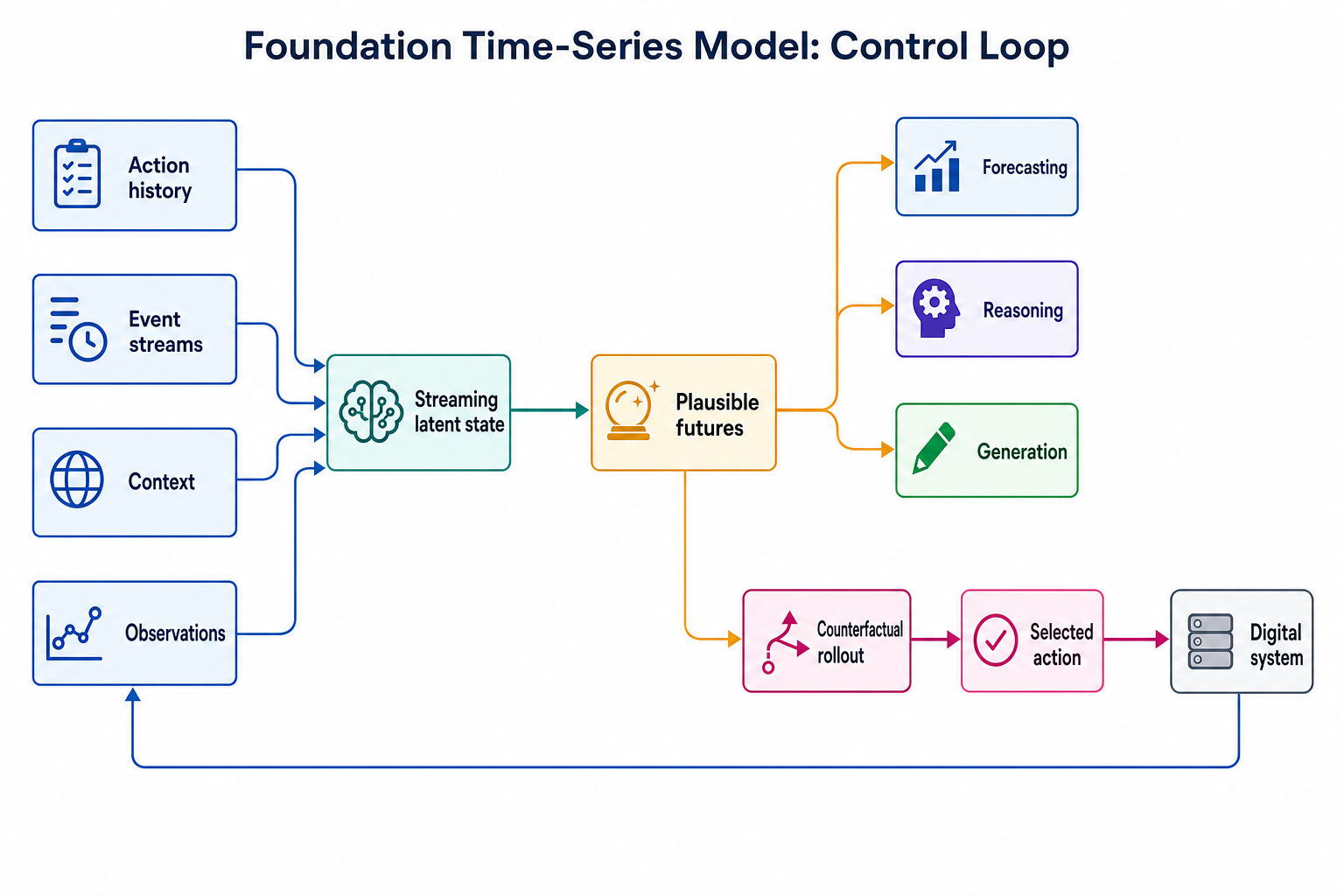
The practical target is to build digital-world robots: agents for digital, organizational, and cyber-physical systems that can observe, remember, simulate, and act. A foundation time-series model is not the whole robot. It is the state and dynamics layer underneath the agent.
The robotics analogy is intentional but bounded. A physical robot has sensors, embodiment, control inputs, and a world model. A digital-world robot has telemetry, logs, traces, business events, topology, calendars, customer or user context, configuration, deployment machinery, safety constraints, and typed intervention capabilities. Its “body” is the system it can observe and affect.
This is not limited to SRE or telecom. Those are the current focus because they provide dense time-series streams, explicit system structure, and relatively clear intervention surfaces. The same frame should eventually cover digital marketing, sales operations, supply chains, finance, industrial systems, and safety-critical infrastructure such as nuclear power plants. The common requirement is a model that can represent system state, evaluate plausible futures, and reason about action consequences.
The digital-world frame is broader than observability alone. CWM is the current code-domain precedent: it treats Python execution and agentic repository work as action-observation trajectories. That is useful evidence for the data contract, but it remains outside numeric time-series modeling because its observations are program states, files, command output, and tests rather than telemetry streams.
MiniMax Sparse Attention adds a different long-context scaling lesson from the agentic-model side: if digital-world robots need million-token histories, the bottleneck is not only model state but also the attention and serving kernels that read that history. For this agenda it is a serving/architecture analogy, not evidence that sparse block selection preserves telemetry state.
Gated DeltaNet supplies the scalar-gated recurrent-memory baseline for this long-context branch, while Gated DeltaNet-2 separates erase and write in the fixed-size state. Oryx, Hybrid Associative Memories, and HOLA add a complementary long-context lesson: exact attention or explicit KV memory can be routed, thresholded, or kept under a fixed top- budget rather than uniformly applied. For this agenda, that is a plausible mechanism for protecting rare events, exogenous context, topology changes, and action windows, but only after benchmark probes show that the selector does not erase predictable but decision-critical state. HOLA’s rule is a useful low-cost signal, but it measures recurrent-state update magnitude rather than downstream control value.
Agentic World Modeling makes the broader taxonomy explicit: digital world models operate under software laws such as API contracts, UI state machines, file-system logic, permissions, and error branches. That is directly relevant to digital-world robots, but it also sharpens the missing piece for this agenda: SRE and operations need the same action-conditioned simulator contract over numeric telemetry, graph time series, event streams, and typed interventions.
Agentic Automata Learning adds a controlled negative test for the LLM-agent side of this picture. Even when the hidden environment is an exact DFA and the agent receives crisp membership/equivalence-query feedback, LLM agents still struggle to plan informative queries, reuse accumulated evidence, and infer a stable hidden model as state complexity grows. For digital-world robots, this is a warning: a tool-calling LLM with long context is not automatically the latent-state or dynamics layer.
Awesome Agentic Time Series is the time-series-specific survey/list counterpart. It frames agentic time-series systems as closed-loop temporal decision systems with perception, reasoning, planning/action, memory/knowledge, temporal world models, and reliability constraints. For this agenda, it is a current field map and candidate-ingest queue, not primary evidence that any listed system already solves action-conditioned TSFM modeling.
World Model for Robot Learning Survey adds the robotics-specific boundary: for embodied agents, visual future prediction is not enough unless the predicted futures remain action-sensitive, physically executable, and useful for policy evaluation or planning. The TSFM translation is that intervention-conditioned rollouts should be judged by downstream decision utility, not only by passive forecast error.
On Training in Imagination adds a data-economics boundary for that same interface: the transition model and the reward or outcome model can have different sample costs, scaling exponents, and noise/bias profiles. For digital-world robots, the analogous split is telemetry/action-transition data versus human, SLO, or expert reward labels.
In agenda terms, the foundation time-series model supports this interface:
observations + context + action history
  -> latent state
  -> plausible futures under candidate interventions
  -> selected action or control input
That is why this agenda tracks streaming state, context, multi-modal future distributions, native multivariate encoding, event streams, causality, counterfactuals, dynamic compute, and benchmarks. Each slot is a missing capability on the path from passive time-series modeling to action-conditioned digital-world agents.
Existing local anchors:
- AI North-Star Terminology maps broad goal terms such as AGI and SAI back to measurable time-series and world-model interfaces.
- Observability Time Series covers the closest SRE/telemetry testbed.
- World Models provides the general state, future, and action-consequence frame.
- Digital World Models covers the software-defined branch of action-conditioned simulators.
- Slow Thinking For Robotics And Time Series connects physical robotics, telecom, and operational time-series systems through layered state/action interfaces.
Capability Target
The target model should expose at least these capability surfaces:
| Capability | Required Interface | Why It Matters |
|---|---|---|
| Forecasting and imputation | history, context -> future observation distribution | Basic utility, but not enough for system understanding. |
| Classification and anomaly detection | history, context -> labels, regimes, events | Tests whether representations preserve discriminative state. |
| Reasoning and question answering | history, context, query -> answer or explanation | Needed for human-facing analysis and incident understanding. |
| Generation | conditions -> plausible time-series samples | Requires calibrated distribution modeling, not only point forecasts. |
| Modification and editing | history, edit instruction -> modified series | Requires preserving original dense detail while changing selected factors. |
| Control | latent state, context, candidate actions -> future trajectory distribution | The central world-model target: choose actions by evaluating consequences. |
The capability target immediately creates a representation tension. A purely semantic embedding may be excellent for labels or decisions, but too lossy for generation and editing. A purely dense reconstruction embedding may preserve values while failing to capture regimes, causal variables, or action-relevant state. The research agenda is to make that tradeoff controllable rather than accidental.
Learning is Forgetting gives a useful adjacent language-model frame: better representations can be understood as lossy compression of objective-relevant information. For this agenda, the open question is which objective makes a time-series model compress toward action-relevant latent state rather than only average next-observation prediction.
TimeCraft and its referenced Microsoft Research papers sharpen the generation part of the interface. TimeDP conditions on target-domain prototypes, BRIDGE conditions on text and prototypes, TarDiff and OATS optimize synthetic samples for downstream utility, CaTSG separates observational, interventional, and counterfactual generation, Diff-MN targets continuous generation from irregular observations, and DiGA plus MarS move into financial-market simulation. The key lesson is that generation should be classified by its conditioning contract, not only by sample realism.
Problem Map
1. Streaming State, Long Context, And Constant Updates
Real systems produce data continuously. The context is not just long; operationally it is unbounded, with a finite retained window and new observations arriving all the time. A useful model must update state at least as fast as real time, avoid recomputing the full history after every sample, and preserve the information needed for future decisions.
Relevant existing pages:
- Latent-State Time-Series Modeling
- Streaming Latent-State Updates
- Extra-Long Context For Time Series
- Time-Series Scaling And Efficiency
- Efficient Recurrent Sequence Models
- Observability Time Series
Useful evidence so far: recurrent or compact-state backbones, contiguous patch masking, efficient decoding, state-space models, rank compression, selective recurrent memory editing, and sleep-time consolidation all help with parts of the problem. They do not by themselves prove always-on latent-state maintenance.
Audio Interaction Model is demoted to a context-level real-time interaction warning. Its explicit serving loop, silence/response decision, FIFO asynchronous inference, first-chunk latency, stall-rate reporting, and proactive trigger evaluation are useful benchmark prompts, but the paper relies on heavy audio preprocessing, synthetic stream composition, history-review probes, and scheduling rather than solving retained-state growth. The TSFM version should keep the serving-contract questions while rejecting the curated-data workaround as a core solution.
Awesome Agentic Time Series reinforces the evaluation boundary for this slot: memory is a capability layer only when it changes future temporal behavior in an auditable way. Context-window summaries, retrieved cases, and procedural traces should therefore be tested for stale-memory failures, regime retention, action relevance, and state-update cost rather than counted as solved memory by design.
Language Models Need Sleep is the clearest current analogy for infinite-context streaming: an SSM-attention hybrid spends extra compute before a finite attention window is evicted, writes a better fast-weight state, then continues with cheap wake-time prediction. The TSFM version would be a learned state-refresh step over recent numeric observations, events, context, and action history before raw samples leave the retained window.
FADE adds a parameter-level continual-learning analogy: memory horizons can be adapted rather than fixed globally. That is not yet TSFM evidence, but it sharpens the requirement that online systems need selective forgetting of stale mappings while retaining stable dynamics and rare safety-relevant state.
TurboQuant adds a serving-memory warning for this slot: retained-state compression must beat hardware-native baselines after dequantization, latency, throughput, and memory-pressure regimes are counted, not only reduce bytes.
Latent Context Language Models and Compress & Attend Transformers add upstream language evidence for learned context compression before or during decoding. The TSFM analogue is a retained-history interface where raw recent observations stay high resolution while older history becomes compressed latent state. This remains adjacent until tested on multivariate numeric streams, event streams, exogenous variables, control inputs, and interventions.
Gated DeltaNet-2 adds an adjacent memory-editing hypothesis for this slot. It shows that, in language-model recurrent state, separating key-side erase from value-side write can reduce interference under fixed state size. The TSFM translation is not “use this architecture as-is,” but “test whether stale-association erasure and new-observation commitment need separate controls when state must preserve rare regimes, channel relationships, events, and action history.”
Streaming Latent-State Updates now owns the dedicated page for online inference cost, retained memory, state refresh, abstain/trigger behavior, and real-time serving contracts.
2. Multi-Modal Future Distributions
This agenda uses multi-modal here in the probability-distribution sense, not the data-modality sense. Many real systems have several plausible futures. A model that averages incompatible futures can be numerically smooth and operationally wrong.
This matters for forecasting, generation, modification, and control. A control system needs to know not only the expected future, but also which future regimes are plausible under uncertainty and which actions change the probability mass.
Relevant existing pages:
- Probabilistic JEPA Predictor Using Flow Matching
- Latent-State Time-Series Modeling
- World Models
- Energy-Based Models
Useful evidence so far: probabilistic forecast heads, flow matching, diffusion-style generation, energy-based framing, and latent-variable world models are all partial routes. World Models is the historical action-conditioned example: an MDN-RNN models a distribution over the next latent state, and temperature exposes the tradeoff between exploitable deterministic dreams and overly noisy imagined environments. The missing test is whether the model preserves multiple decision-relevant future states rather than only calibrated marginal forecasts.
Expectations vs. Realities adds the direct numeric time-series warning behind this slot. It proves that, whenever irreducible conditional uncertainty is nonzero, the MSE-optimal deterministic conditional mean has lower marginal variance than realized futures and cannot simultaneously be marginally realistic. Across nine real benchmarks, a 5% MSE tolerance exposes a median 17.3% attainable marginal- gain. This establishes why one average future and one point-error leaderboard are insufficient, but it does not close multi-modal future modeling: marginal agreement does not identify separated modes, correct per-context futures, calibrated mass, coherent trajectories, or action-sensitive shifts.
VJEPA is the clearest current JEPA-side bridge for this slot. It turns a deterministic latent point prediction into an explicit conditional distribution over future latent states, connects time-indexed latent prediction to Bayesian filtering, and supports sampled belief rollouts for stochastic model-predictive control. BJEPA adds a modular Product-of-Experts prior that can represent goals, physics, feasibility, or safety constraints separately from reusable learned dynamics.
The crucial limitation is also exactly aligned with this agenda. VJEPA’s evaluated head is an independent diagonal Gaussian: it is unimodal and mainly represents latent predictive or aleatoric uncertainty. The architecture can host mixtures, flows, or other expressive families, but the current results do not show distinct future modes. The later ICML poster also shows that probabilistic JEPA is not uniformly better than deterministic JEPA: VJEPA leads the five-environment linear Noisy-TV study at moderate nuisance scale, while deterministic JEPA is strongest and most stable at the hardest scale. This source therefore strengthens the research requirement without closing it.
FlowWM is the closest current positive result for the expressive-family gap. It performs conditional flow matching over structured future DINOv3 feature trajectories and uses an enumerable Bouncing Shapes benchmark to separate sample validity from mode coverage. The full model reduces F1 mode error to , versus for the prior stochastic feature-space baseline and for a matched deterministic predictor.
That result partially closes a narrow visual version of this slot, not the foundation-TSFM target. The benchmark does not score predicted mode frequencies, unequal or rare branch probabilities, or action-sensitive mass shifts; FuturePerception uses best-of- oracle selection; and the model has no action or control-input channel. FlowWM also uses frozen DINOv3 features rather than a jointly trained JEPA representation and does not compare against a matched direct raw-trajectory flow.
IMLE and conditional IMLE establish the historical candidate-width route; Explorative Modeling supplies the modern scaling, hybrid-generator, and cross-modal evidence. Direct conditional Forward XM uses the same per-condition hard objective as conditional IMLE, while XM reports positive mode/sample coverage across image, video, masked language, behavior cloning, and goal-conditioned Maze2D. This partially closes the proposal-coverage mechanism outside numeric time series and supplies a required baseline for probabilistic JEPA work. It does not close calibrated predictive belief: the hard minimum need not recover mode mass, and the control evidence lacks a broad stochastic action-conditioned benchmark and released control code.
Probabilistic JEPA Predictor Using Flow Matching turns that requirement into a properties-first experiment. It treats conditional flow matching over future JEPA latent trajectories as the primary architecture candidate, compares it against direct raw-trajectory flow, and requires oracle-decoder ceilings, separated-mode calibration, tail-risk probes, decoder-use ablations, action ranking, and quality/latency frontiers before the JEPA latent route receives credit.
Beckmann Transport Models adds adjacent transport evidence and a sharper warning for this slot. An autonomous or direct one/few-pass map can reach the correct target support while allocating probability mass badly across its basins. The paper’s weighted-atom result makes support-versus-mass error explicit, but it does not test conditional numeric futures or action-sensitive probability shifts. It therefore strengthens the calibration and serving-cost requirements without closing the TSFM slot.
Denoising Thermodynamic Models add another adjacent generative substrate. Chaining several conditional EBMs can avoid asking one rugged monolithic energy landscape to mix across every mode, and ACP explicitly monitors sampler correlation. The paper does not test calibrated future-mode mass, numeric trajectories, or actions, so this is a hardware-oriented mechanism hypothesis rather than slot-closure evidence.
For this agenda, a credible multi-modal-future result MUST report more than CRPS, quantiles, or sample diversity. It SHOULD test separated regime coverage, probability calibration, invalid between-mode trajectories, tail-risk recall, multivariate constraint preservation, and whether candidate actions or interventions move mass among future regimes correctly.
ELF adds a cross-modality substrate analogy rather than direct evidence for this slot: text generation can stay in a continuous embedding-space flow and decode to tokens only at the final step. It remains adjacent until a TSFM demonstrates multiple calibrated numeric future modes under text/context conditioning and downstream utility.
Latent Thought Flow adds an adjacent latent-trajectory analogy for this slot: a reward-proportional posterior over hidden reasoning paths is conceptually close to preserving multiple candidate futures, but the paper tests answer reasoning rather than calibrated numeric trajectories or action-sensitive futures.
The Flexibility Trap adds proposal-coverage evidence from diffusion language models: a flexible confidence-driven reveal order can look competitive at Pass@ while flattening as the sampling budget grows. For this slot, one-sample forecast quality is therefore insufficient; a time-series generator should report whether distinct valid regimes, rare trajectories, and action-dependent futures remain reachable under its commitment schedule.
Why Diffusion Models Don’t Memorize is warning evidence for this slot: diffusion/flow generators may show useful sample quality before later memorization, so future-distribution evidence should include checkpoint age and copying/leakage probes, not only quality or calibration metrics.
Diffusion Consistency RMT adds a reproducibility warning for deterministic diffusion/flow generators: same base-noise agreement across independently trained models can indicate shared dominant covariance structure rather than calibrated multi-modal future modeling. TSFM generation reports should therefore slice same-noise consistency by regime, channel/frequency or latent-state direction, and horizon, and keep it separate from mode coverage and downstream utility. Because the source is only adjacent or warning evidence for TSFMs, it belongs in this slot discussion rather than the compact coverage matrix.
3. Data Diversity, Curriculum, And Long Tail
Real time-series corpora are useful-signal-poor. Normal operation dominates, while failures, regime changes, interventions, tail users, rare devices, unusual weather, unusual demand, and edge-case patient states are sparse.
Dynamic Curriculum Learning For JEPA frames the local idea: use model surprise to spend training compute on windows that still carry learning signal. Distribution Priors In Self-Supervised Learning adds the caution: anti-collapse losses and batch construction can impose hidden distribution priors that are harmful under long-tailed data.
Research should be scored by whether it improves rare-state preservation, not just average loss. A method that accelerates training on common patterns but erases rare regimes moves away from the foundation-model target. LLMs as Noisy Channels adds the parallel scaling caveat: average-loss scaling can be monotonic only while the useful signal stays ahead of accumulated noise.
The internal discussion behind the dynamic-curriculum idea sharpens this slot. The problem is not only that real corpora are noisy; it is that normal operation can dominate so heavily that the model learns to treat failures, regime shifts, and corner cases as ignorable noise. The research agenda should therefore split the work into two questions: dataset-level curriculum over unlabeled useful-signal-poor corpora, and model-level robustness so the encoder does not discard rare correlated events when the data distribution is unknown.
Noise or Signal? adds a direct preprocessing version of the same warning. Its DLinear study shows that mean/std RevIN can be dominated by an extreme window, but it also explains why a robust median/MAD transform can suppress a spike that actually announces a new regime. The evidence is too narrow and internally inconsistent to select one universal normalizer. The durable agenda requirement is to treat normalization as part of the information-preservation policy: compare corrupt-window robustness with rare-event, change-point, raw-amplitude, and downstream-state retention, and carry scale/unit/statistic context when removing it would make the signal unrecoverable.
Implicit Curriculum Hypothesis adds a checkpoint-monitoring version of this slot. It is LLM-only evidence, but it suggests that a useful TSFM curriculum should not only improve average loss; it should make latent-state capabilities emerge in a measurable order, with absolute thresholds for rare regimes, channel coupling, context use, and intervention-sensitive state.
Adjacent evidence from Synthetic Data for any Differentiable Target suggests a stronger but expensive version of curriculum scoring: estimate an example or window by its downstream training effect through a differentiable probe. For TSFMs this is only a hypothesis, because DPG is text/SFT evidence, but it sharpens the requirement that rare-state curricula report metric-target overfitting and hidden representation drift alongside matched-compute gains.
Conditional Autoencoders for Electrical Consumption is a narrow energy-domain example: expert-conditioned residual latent spaces made sparse holidays, bridge days, snow or cold snaps, and vacation effects visible, but the evidence is a single passive national-load dataset rather than a scalable curriculum method.
Bitter Lesson for Data Filtering adds the compute-scale caution: in LLM pretraining, ordinary quality filters can help at small compute, but larger models trained longer may extract more value from the raw data pool. The TSFM translation is that filtering should be compared against no-filter or loose-filter baselines at matched FLOPs, and the winning policy may change with model size and training duration.
LLMs as Noisy Channels adds an upstream scaling-law warning: more tokens can eventually add more noise than signal when the data-noise exponent dominates the signal exponent. The TSFM version should not assume that adding more normal-operation windows always helps; scaling studies should track useful-signal density, corrupt observations, repeated steady state, missingness, and rare-regime retention.
Scaling Laws, Carefully adds the compute-allocation version of the same warning. In data-limited scaling, repeated tokens are not equivalent to unique tokens, and larger models can be more sensitive to repetition. The TSFM analogue is repeated normal-state telemetry: a training run can be FLOPs-matched while still optimizing around the wrong effective-data count if rare structured windows and intervention windows are not tracked separately from redundant normal windows.
No Filter adds the benchmark-mismatch caution: an English-only VLM data filter can improve ImageNet/COCO while degrading cultural and socioeconomic coverage. The TSFM analogue is a sampler that improves average forecast error while erasing tail devices, tenants, regions, regimes, interventions, or pre-failure states.
SensorFM is useful positive evidence for scale and diversity in this slot because it trains on >1T minutes from >100 countries and >20 devices. It is also a caution: a private wearable-user corpus can still be long-tailed, missingness-heavy, and biased by who owns and wears the devices, so data volume is not a substitute for subgroup and rare-state reporting.
AnyMo adds a structured-synthetic route: instead of generating unrelated time series, it samples many physically plausible sensor placements and orientations for the same body motion. This partially closes setup-nuisance coverage, while AnyMo Bench exposes a 150-class long-tail test. The remaining question is whether one Nymeria-derived body model and co-located device shift cover truly new manufacturers, loose mounting, and body populations.
The publishable test is matched-compute, not just “more filtering.” A useful result should report rare-event or rare-state metrics, normal-behavior retention, corrupt-window robustness, no-filter and dedup-only baselines, and whether the same surprise policy transfers between multivariate time series and image/video trajectories.
4. Augmentation-Free Or Dataset-Aware Self-Supervision
Time-series augmentations are not universal. Jitter, cropping, scaling, warping, masking, permutation, and frequency transforms can be valid for one domain and destructive for another. A foundation model trained across many datasets cannot assume one augmentation family is always label-preserving or state-preserving.
This creates two routes:
- build a large library of dataset-aware augmentations and metadata rules;
- prefer objectives that need fewer handcrafted augmentations, such as latent prediction, masked modeling with careful grounding, next-state prediction, or world-model objectives.
Self-Supervised Representation Learning, JEPA, and Latent-Space Predictive Learning are the current anchors. A source helps this problem when it reduces dependence on brittle augmentation assumptions while preserving state variables and dense numeric detail.
Learn From Your Own Latents And Not From Tokens is useful here as adjacent theory: it shows a synthetic hidden hierarchy where own-latent targets avoid an exponential surface-token sample-complexity cost. The agenda should not treat that as time-series evidence until the mechanism survives irregular sampling, long-tailed regimes, exogenous variables, and dense numeric-value preservation.
NextLat moves that own-latent intuition into a practical autoregressive Transformer objective: predict the model’s own next hidden state while retaining next-token supervision. The TSFM transfer is to test next-state or next-hidden objectives that require fewer handcrafted augmentations, but only if they preserve rare regimes, dense numeric detail, exogenous context, and action history.
LeNEPA partially closes the augmentation-free branch in a narrow time-series SSL setting: the tested recipe removes handcrafted augmentations and stop-gradient/EMA targets while keeping useful frozen-probe gains under a fixed-recipe PTB-XL/Diag stress test. It does not close the broader slot until the same recipe is tested on multivariate, irregular, event-stream, long-tailed, and action-conditioned data.
SensorFM is not augmentation-free in the same sense, but its LSM-2/AIM lineage treats natural missingness and artificial masking as a unified reconstruction interface. That partially closes the missingness-aware SSL branch for regular minute-level wearable streams, while leaving event streams, irregular timestamps, and action-conditioned settings open.
AnyMo is dataset-aware rather than augmentation-free: body geometry determines which setup transformations are physically meaningful, and the masked cross-view objective predicts an independently sampled full setup latent from one to five visible sensors. This partially closes setup-aware self-supervision for fixed wearable body topology, but dense-state preservation and matched ordinary-augmentation baselines remain open.
5. Context Interface: Channel Context And General Context
Context has two separate roles.
Channel context describes what each channel means: metric name, unit, sensor type, topology node, service, region, product, physiological variable, protocol layer, or actuator. Without it, a multivariate model can see numbers but not know what the numbers are.
General context describes the system and situation: season, holiday, maintenance window, deployment, weather, user segment, market condition, topology, known incident, experiment setting, or operating mode.
Context is Key is the clean benchmark anchor for text-conditioned forecasting, while CHARM is the local source for channel-description-conditioned multivariate representations. These are partial answers: they show that context can matter, but they do not yet provide a full context interface for high-dimensional streaming systems with actions and event streams.
AnyMo adds body-location context plus natural-language activity/narration context. The location prompt tells the model which sparse graph nodes are visible, and the language side supports retrieval and captioning. This is a concrete context interface, but the paper does not yet test corrupted location metadata, contradictory text, or action/control semantics.
Impact-Driven Event Embeddings adds a non-text context path: it learns response- and timing-aware covariates from recurring events and supplies them to zero-shot Chronos-2. This partially closes a narrow future-known event-context interface, but only on a synthetic financial benchmark. The benchmark generator and code are not public, transfer is across accounts rather than novel events or noisy calendars, and the events are exogenous context rather than actions or interventions.
Research should be scored by which context type it handles and whether context is actually necessary for the target, not merely decorative metadata.
6. Representation Quality: Semantic State Vs Dense Numeric Detail
The model needs semantic state for regimes, events, causal variables, and decisions. It also needs dense numeric detail for high-fidelity forecasting, generation, imputation, and modification.
EIDOS is the local time-series anchor because it predicts latent representations while grounding them back to observations through a reconstruction head. LeNEPA adds the no-augmentation next-latent SSL variant and exposes intermediate-layer frozen probes. Aionoscope adds the diagnostic benchmark: component identity can be easier to recover than dense timing, phase, amplitude, frequency, and regime parameters. NextLat adds a complementary hidden-state supervision lesson from language models: ordinary output accuracy can hide poor internal map quality, so representation probes and latent rollout diagnostics should accompany forecast/generation scores. Reconstruction Or Semantics? shows the robotics version of the same conflict: semantic latents can be more policy-relevant than reconstruction latents, but dense fidelity still matters for geometry and contact. FlowWM adds stochastic feature-space evidence: DINOv3 flow outperforms a VAE-latent world model on perception, while a large ground-truth-feature oracle gap and the absence of a matched raw-space flow keep dense-fidelity and factorization questions open. Implicit Curriculum Hypothesis adds an upstream diagnostic: internal representations can predict later capability trajectories, so TSFM layer/probe APIs should be evaluated not only for final transfer but for whether they forecast future state-skill emergence.
Aristotelian Representation Hypothesis adds the measurement hygiene for this slot: representation-similarity probes should report calibrated nulls and distinguish global geometry, local neighborhood structure, and downstream dense-state utility. For temporal data, those nulls must preserve dependence structure rather than arbitrarily shuffling timestamps.
AnyMo adds an explicit semantic-compression case: a time-preserving body-graph latent is reduced to two product-code streams and then aligned with language. High code usage, low exact-sequence collision, and recognition/retrieval/captioning transfer are positive diagnostics, but they do not show which dense motion variables, rare states, or uncertainty survive quantization.
The unresolved target is inference-time control over what information is preserved. A model should not use one fixed representation policy for every query. Forecasting a smooth seasonal signal, editing a spike, detecting an incident, and choosing an intervention may require different layers, heads, or latent subspaces.
Research directions to track:
- auxiliary losses that keep dense numeric information available in deeper layers;
- intermediate-layer access rather than only final-layer representations;
- depth-wise attention or attention-residual mechanisms that let later layers retrieve earlier representations;
- task-conditioned readout from semantic and dense states;
- probes that test reconstruction, generation, modification, decision relevance, and capability-emergence timing separately.
The local JEPA-curriculum notes add a concrete NEPA-style warning for this slot: in a next-embedding-prediction time-series setup, moving the target from patch-independent embeddings to contextual or internal-layer representations made latent prediction worse when those targets appeared to mix away local differences.
7. Anti-Collapse Regularization
Avoiding constant collapse is necessary but not sufficient. A representation can be non-collapsed and still learn the wrong factors, such as slow distractors, common regimes, or nuisance variables.
Representation Collapse tracks this cluster. JEPA Slow Features is the warning source, while LeJEPA, When Does LeJEPA Learn a World Model?, LeWorldModel, and LeNEPA anchor Gaussian or distribution-regularized JEPA/NEPA-style approaches. Sensorimotor World Models adds the action-grounded alternative: inverse dynamics can prevent full collapse by requiring latent transitions to recover the logged action, but it can also intentionally collapse variables outside the action repertoire. The identifiability result is especially useful because it distinguishes a non-collapsed embedding from a linearly usable latent state under stated Gaussian/OU assumptions. The Hidden Uniform Cluster Prior adds the long-tail warning: the anti-collapse prior itself can bias what the model preserves.
For foundation time-series models, the key question is whether regularization preserves rare regimes, cross-channel deviations, intervention effects, and multiple plausible futures. SMWM makes this sharper: an action-recovery objective may preserve controllable state better than an arbitrary distribution prior, but only if the logged actions are rich enough and the evaluation still checks action-irrelevant safety or diagnostic variables.
8. Patch Size, Dynamic Tokenization, And Point-Wise Numeric Embeddings
Fixed patch size is a hidden modeling assumption. The right temporal resolution varies across datasets, across channels, and even inside one signal. A quiet hour of server metrics and a bursty incident window should not be encoded at the same density.
The agenda needs both extremes:
- adaptive patching for redundant or low-information spans;
- point-wise numeric embeddings for cases where every sample may matter.
ReinPatch and Kairos are current adaptive-tokenization anchors. EIDOS is the point-wise numeric-token anchor. Number Tokenization tracks related scalar encodings such as Fourier, bit-level, and typed numeric embeddings.
Compute Optimal Tokenization adds an upstream scaling-law constraint: if granularity changes, the unit used to state scaling laws must change too. For text, the paper argues for bytes per parameter rather than tokens per parameter. A time-series foundation model needs the analogous unit before claiming compute-optimal patching or compression, and that unit may differ for dense samples, sparse event streams, high-channel telemetry, and action logs.
Scaling Laws, Carefully adds the fitting caveat for that unit choice. A patching or tokenization result should not infer a compute-optimal granularity from one run; it should expose the compression or active-token target as a scaling variable and test whether the fitted optimum is stable across model size, effective data, and fit region.
A source helps this problem when it makes token granularity data-dependent without erasing change points, spikes, missingness, local causal events, or channel-specific deviations.
9. Native Multivariate Encoding And High-Channel Scaling
Multivariate time series cannot be reduced to a slogan like “embed separately” or “embed together.” Channel-independent models improve transfer and serving simplicity, but can miss cross-channel dynamics. Naive channel-dependent attention can become too expensive and noisy.
High-Dimensional Time Series Forecasting is the current topic page. U-Cast and Time-HD anchor thousand-channel passive forecasting. Toto, Toto 2.0, and BOOM anchor the observability version at grouped-query scale.
Graph Structure As Transformer Context tracks the topology-conditioned branch: when channels are nodes and edges in a known graph time series, the model should compare graph-context interfaces instead of flattening topology into anonymous channel order.
Topological Neural Operators adds a scientific-ML boundary case: when quantities naturally live on different supports, such as nodes, edges, faces, or volumes, native structured encoding should preserve that support instead of flattening it into anonymous channels. This is adjacent to graph time series, not proof of action-conditioned TSFM control.
SensorFM adds a smaller but concrete native multivariate case: 34 wearable numeric features from five sensor families are encoded jointly over 24-hour windows. It partially closes the wearable-sensing version of multivariate representation learning, but not high-channel telemetry, graph time series, or arbitrary channel schemas.
AnyMo adds graph-conditioned wearable multivariate structure: a fixed 23-node kinematic tree organizes six numeric features per body segment and masks unobserved nodes. It partially closes sparse multivariate setup transfer, but remains body-specific, low-dimensional at inference, and far from arbitrary channel schemas or high-dimensional telemetry.
Research should be scored by:
- whether it is channel-independent, channel-dependent, factorized, hierarchical, graph-conditioned, or retrieval-based;
- whether it preserves cross-channel interactions;
- whether it scales to hundreds, thousands, or tens of thousands of channels;
- whether it handles channel metadata and topology;
- whether it stays passive or introduces actions/control inputs.
10. Time Representation And Irregular Event Streams
Regular time series can often use sample index as a proxy for time. Irregular time series and event streams cannot. The model may need elapsed time, calendar time, sampling rate, event order, duration, missingness, seasonality, and asynchronous channel updates.
T-Rep is the current source for learned time embeddings. FlowState is relevant because it uses coefficient-space and continuous basis decoding for flexible sampling rates. The broader wiki still needs a dedicated topic page for time representation across regular samples, irregular time series, event streams, continuous time, and calendar time.
Research helps this problem when it makes time a first-class input rather than an accidental positional index.
MIRA is now the strongest local medical example for this slot: Continuous-Time RoPE handles real-valued timestamps, a Neural ODE extrapolation block evolves latent state to arbitrary target times, and frequency-specific MoE layers specialize over temporal regimes. Diff-MN complements it from the generation side by using irregular observations to condition continuous trajectories through diffusion-generated MoE-NCDE dynamics. Both partially close irregular-time modeling, but neither yet demonstrates always-on streaming state with explicit action, control-input, intervention, or treatment channels.
medDreamer adds the missing treatment-conditioned branch: per-feature elapsed times and masks feed a latent patient model that is rolled forward under logged interventions. It partially closes irregular-time plus action-conditioned interface shape, but not continuous-time generality or causal treatment-response validity.
HUMI adds a narrower event-to-numeric measurement layer. It scans lagged dependence between categorical event labels and numeric observations without binning the time series or imposing ordinal geometry on event IDs, and it uses the same mixed-type score to rank forecast covariates. This partially closes the event-context screening interface, not event-stream state modeling: timestamp alignment is preconstructed, marginal dependence can retain redundant or confounded context, and the paper provides no asynchronous parser, online update, action/control-input semantics, or counterfactual transition model.
11. Dynamic Compute Allocation
Easy windows and hard windows should not receive identical computation. Dynamic compute can happen through sparse experts, recursive or looped depth, pause or thinking tokens, adaptive inner steps, hierarchical compression, or energy-based search.
Revenge of Monosemanticity adds an adjacent synthetic warning: local specialization can arise inside a dense MLP without sparse dispatch. Dynamic-compute claims therefore need to distinguish feature specialization, routing, sample efficiency, and realized conditional computation; this source does not close the TSFM slot.
Current local anchors:
- Mixture Of Experts
- Time-Series Scaling And Efficiency
- Hierarchical Modeling with a Fixed FLOPs Budget
- Energy-Based Models
- EBT
- Looped Transformers And Test-Time Memory
- MoDA
- mHC
- Hyperloop Transformers
- ELT
- Language Models Need Sleep
- LT2
- DMax
- iLLaDA
- The Flexibility Trap
- The Thinking Pixel
- The Illusion of Superposition
- Latent Thought Flow
- Looped World Models
- NextLat
- Variable-Width Transformers
- Scaling Laws, Carefully
H-Net, ConceptMoE, Compute Optimal Tokenization, and Scaling Laws, Carefully are useful architecture and scaling analogs for learned hierarchy and implicit compute allocation. Scaling Laws, Carefully is especially a methodology source: a dynamic-compute claim should compare allocation frontiers across budgets and effective-data regimes, not only one matched-FLOPs point. EBT adds an explicit search path: score candidate predictions with an energy function, then spend more optimization steps or more candidate samples when the prediction is hard. The time-series-specific target is stronger: allocate compute to spans, channels, regimes, and candidate futures that matter for latent-state maintenance and control.
Scaling Test-Time Compute for Agentic Coding is an adjacent runtime-compression example: long action-observation traces become more useful after structured summarization, selection, and refinement. The transfer target is not raw prompt summarization of telemetry, but learned state compression that preserves action-relevant facts under a compute budget.
Latent Context Language Models adds the compressed-global-view plus exact-local-expansion pattern through its EXPAND(i) agent harness. Compress & Attend Transformers adds a test-time chunk-size knob. Both are useful dynamic-compute analogies, but the TSFM version needs learned budget allocation based on event density, state uncertainty, anomaly risk, or action relevance rather than a manually chosen text chunk size.
DiffusionBlocks adds an adjacent training-memory route: local denoising objectives can reduce full-depth backprop memory and recurrent-depth BPTT cost, but pretrained conversion, privacy, and numeric time-series state preservation remain untested.
DMax adds the decoding-side counterpart to the training-memory and looped-depth branches: aggressive parallel diffusion decoding can reduce serial generation steps only when intermediate predictions remain self-correctable. For TSFMs, treat OPUT/SPD as adjacent evidence until numeric horizon, event-stream, and action-conditioned rollout benchmarks show that soft intermediate states preserve rare regimes, dense values, exogenous variables, and interventions under matched latency.
iLLaDA adds the from-scratch scale signal for that diffusion-language branch: an 8B masked diffusion LM can be trained on 12T tokens with variable-length generation and strong base-model benchmark results. For this agenda it stays adjacent because the evidence is text-only, the scoring protocol includes a confidence-based multiple-choice surrogate, and the instruct model still trails Qwen2.5 Instruct; it does, however, make diffusion sequence models worth tracking for future horizon-generation and revisable-rollout experiments.
The Flexibility Trap separates the dynamic-compute budget across phases: sequential left-to-right rollouts during RL can improve exploration and exact credit assignment, while parallel decoding remains available at inference. The TSFM test is whether decision-critical timestamps or action consequences should be exposed sequentially during training while low-entropy future regions are generated in parallel, with forward passes, wall-clock cost, memory, coverage, and leakage all matched.
The Thinking Pixel adds a continuous-latent dynamic-compute analogue: sparse recursive adapter experts refine visual diffusion tokens inside joint attention. For TSFMs, the useful transfer is not text-to-image quality; it is the question of whether spans, channels, regimes, or candidate futures should receive extra routed latent updates before output. The missing test is matched-latency numeric and action-conditioned evidence plus adaptive halting.
The Illusion of Superposition is the caution attached to that whole branch. Soft latent thoughts and fine-tuned latent reasoning can collapse or shortcut even when the interface is continuous. TSFM dynamic-compute claims should therefore include no-latent/no-loop ablations and probes for whether hidden state preserves uncertainty over regimes, events, channels, and candidate futures.
Latent Thought Flow is the positive counterpart to the Illusion warning. It explicitly trains a reward-proportional sampler over variable-length hidden trajectories, so the TSFM analogue would be to allocate hidden compute to candidate latent-state updates or candidate futures under a quality/cost reward. The agenda should still treat this as adjacent until matched wall-clock, no-latent/no-loop, reward-noise, and state-probe tests exist for numeric time-series or action-conditioned rollouts.
Looped World Models is the first source in this looped-depth cluster that directly targets a world-model transition interface: observations and actions update latent state, the recurrent block can spend variable compute per transition, and deferred decoding rolls candidate action sequences in latent space. For TSFMs this partially closes the dynamic-compute and action-conditioned rollout shape outside numeric time series, while leaving public artifacts, matched latency, dense numeric preservation, and operational telemetry benchmarks open.
Fast-LeWM adds a different adjacent visual-control route: action-prefix-conditioned multi-horizon latent prediction reduces candidate-rollout serial depth, with a reported 3.9× dynamics-module speedup but only a 48% full-CEM reduction. Its fixed short horizon, deterministic point predictor, continued CEM dependency, and non-time-series benchmarks keep it below TSFM slot-closure evidence and outside the central coverage matrix.
INTACT moves the compute boundary from faster broad candidate evaluation to amortized state-and-goal-to-control-input inference. Its Direct path reports 2.9—5.5 ms with zero candidates, while a 384-candidate residual CEM path remains available for verification. This partially closes dynamic serving and control-interface shape outside numeric time series, but the evidence is a four-task simulated visual-control preprint with planner-side latency, a unimodal action law, limited OOD routing, and no typed digital interventions.
τ₀-VLA adds adaptive compute at a slower semantic boundary. Token confidence routes routine next-subtask decisions directly; uncertain decisions invoke candidate generation, terminal-image prediction, value scoring, beam expansion, and reflection before a 30 Hz low-level policy acts. This partially closes the dynamic-compute and action-conditioned candidate-evaluation shape outside numeric time series, but task-specific routing thresholds, PFLOPs-only curves, terminal-image point predictions, proprietary judging, and the unreleased high-level stack keep the result far from a transferable TSFM control interface.
Variable-Width Transformers adds a static hidden-width allocation baseline for this slot. It partially closes the narrow architecture question of whether nonuniform depth-wise capacity can beat a uniform Transformer under matched parameters, but it is still language-model evidence: no learned per-input router, numeric time-series benchmark, action-conditioned rollout, or realized heterogeneous-kernel latency result is shown.
Recurrent Transformer depth, depth-state retrieval, residual-stream capacity, loop-boundary supervision, and energy-based optimization loops belong here as adjacent dynamic-compute mechanisms, not as automatic progress on the curriculum slot. Universal Transformers, Huginn, Latent Thoughts, The Illusion of Superposition, Latent Thought Flow, LT2, MoDA, mHC, Hyperloop Transformers, ELT, LoopFormer, Parcae, and Sparse Looped LMs are promising for real-time deployment, early exit, uncertainty signals, linear/sparse looped serving, depth-memory retrieval, residual-state capacity, and bounded-memory inference, but they need matched comparisons against wider or deeper unique-weight models and direct evidence that extra depth compute, cheaper mixers, depth communication, loop-boundary supervision, or residual-stream width preserves decision-relevant temporal state. LT2, Parallel Samplers, and The Recurrent Transformer sharpen the serving contract: dynamic compute must be evaluated against realized throughput, key-value cache traffic, recurrent-state memory, OOM frontiers, and exact decoding schedules, not only nominal FLOPs. MoDA and mHC add the same warning for inter-layer communication and residual-stream capacity: depth retrieval or matrix residual state may help only if the cache, memory bandwidth, and kernel budgets are explicit. ELT adds a useful visual-generation example where intermediate loop exits are trained directly, but TSFMs still need calibrated stopping rules and numeric-state preservation probes. Extra recurrence inside an Energy-Based Transformer is especially a design risk: the EBT inference procedure already has an iterative energy-gradient loop, so the first question is whether the energy landscape or candidate search is the bottleneck.
Language Models Need Sleep adds a consolidation-time version of this question for SSM-attention hybrids. Extra compute is spent before context eviction to write a better fast-weight state, not during every later prediction. For TSFMs, the analogous design would be an online state refresh step at window boundaries in an infinite stream, but the evidence remains language/synthetic until it is tested on numeric streams, event streams, and action histories.
Dragon Hatchling adds a stronger fast-state architecture hypothesis: make the mutable recurrent state a central part of the model, keep sparse positive activations, and probe individual state/synapse behavior. For this agenda it is important but adjacent evidence. It sharpens the streaming-state and dynamic-compute slots, while still missing numeric time-series, event-stream, and action-conditioned tests.
Titans and ATLAS add a complementary memory-at-test-time route. For this agenda, the interesting question is whether memory updates preserve rare regimes, cross-variate relationships, exogenous context, and intervention history, not only whether they improve recall-style long-context tasks.
HRM, TRM, GRAM, URM, and Universal Transformers Need Memory are adjacent recursive-reasoning evidence. They are useful for latent-state refinement, supervision, memory-slot, halting-budget design, and GRAM-style width-based latent-trajectory sampling, but still puzzle evidence until tested on numeric time series, event streams, or action-conditioned trajectories.
Loop convergence itself may be useful as a diagnostic. If a recurrent block needs unusually many iterations before representations stabilize, that can act as an uncertainty or failure signal; if additional loops saturate after a small number of iterations, test-time compute has diminishing returns and should be capped.
Candidate sources to ingest later:
Think before you speak: Training Language Models With Pause Tokensfor delayed next-token prediction.Attention Residualsfor learned access over previous layer outputs.Inner Thinking Transformerfor adaptive internal depth.
These candidates should not be treated as wiki evidence until they have source pages.
12. Benchmarks: What Level Of Modeling Is Tested?
The benchmark question is not “which model has the best score?” It is “what level of modeling did the score test?”
The agenda should separate at least these levels:
| Level | Question | Failure If Missing |
|---|---|---|
| Shape forecasting | Can the model extrapolate visible morphology? | Repeats curves without understanding process state. |
| Latent-state prediction | Does it track regime, constraints, and hidden state? | Good forecast error but weak rare-event and decision behavior. |
| Context use | Does context change the predicted distribution correctly? | Numeric history is treated as complete when it is not. |
| Multi-modal futures | Does it preserve multiple plausible futures? | Averages incompatible outcomes. |
| Causal/counterfactual reasoning | Does it represent intervention consequences? | Confuses passive events with actions. |
| Control utility | Does it choose or rank better actions? | Forecasts well but cannot act. |
Time-Series Benchmark Hygiene is the current page. Future benchmarks should report whether they test observation forecasting, state prediction, context sensitivity, rare-regime preservation, high-dimensional channel interaction, irregular/event-stream handling, generation fidelity, modification fidelity, or action-conditioned rollout.
Aionoscope partially fills the latent-state diagnostic level: it supplies exact categorical and dense latent labels from a controlled generator and shows that dense state can remain weakly accessible even when coarse component presence is easy. LeNEPA is the matching method-side protocol reminder: fixed-recipe reuse is different from fully tuned leaderboard performance.
DiffusionGeometryProbe adds a geometry-probe warning rather than a new coverage-matrix entry: score-derived dimension, tangent, and topology diagnostics should be validated on known latent geometry before they count as representation-quality evidence, because theorem-regime, perturbation-rank, and sample-count artifacts can dominate the reported values.
FlowWM partially fills the multi-modal-futures benchmark level outside numeric time series: Bouncing Shapes enumerates valid futures and reports separate precision and recall errors. Its FuturePerception best-of- score is a useful proposal-coverage diagnostic but should not be mistaken for calibration or a deployable selector because the realized future chooses the winning sample.
Expectations vs. Realities partially fills the numeric forecasting-evaluation level. Its tolerance-band procedure keeps MSE as a declared primary constraint and reports marginal realism on the resulting near-tie set, while its own limitations make clear that marginal is weaker than conditional calibration or trajectory realism. A foundation-TSFM benchmark should retain this cheap under-dispersion test and then add separated-regime coverage, probability mass, tail risk, cross-channel constraints, and decision utility.
Denoising Thermodynamic Models add an evidence-layer benchmark warning: measured circuit primitives, simulated model workloads, modeled complete-system energy, and fabricated end-to-end accelerator results are distinct levels. The ~10,000x Fashion-MNIST estimate belongs to the modeled-system level; a TSFM hardware claim must also report numeric quality, fabrication node, latency, throughput, communication, calibration, and host overhead.
Agentic Automata Learning is not a time-series benchmark, but it is a useful evaluation-design warning: final success should be decomposed into information gathering, evidence integration, hypothesis construction, query efficiency, and non-informative action rate. A TSFM control benchmark should make the analogous decomposition for telemetry observations, event streams, and typed interventions instead of only reporting closed-loop reward.
13. Causal Structure, Counterfactuals, And Control
A foundation time-series model should eventually support counterfactual prediction: what would happen under a different action, control input, or intervention? This is distinct from conditioning on exogenous future events.
Causal Time Series is currently small. CauKer uses causal structure for synthetic time-series generation, while TimeOmni-1 includes causal discovery as a reasoning target. Action-Conditioned Time-Series Datasets tracks the dataset side.
Causal-PIK adds a narrow decision-time control case outside numeric time series: short action-conditioned effect predictions define a GP reward covariance, UCB screens 500 candidates, and probabilistic simulation reranks a five-action shortlist. It demonstrates control utility from effect-space generalization rather than a long-horizon counterfactual rollout. The proposed covariance is also indefinite in general, so the empirical action-selection result should remain separate from the paper’s kernel-validity claim.
The world-model test is whether the model can evaluate future trajectories under candidate actions. Passive forecasting, even when probabilistic and high-dimensional, does not close this problem.
Awesome Agentic Time Series is useful here because it names planning/action and temporal world models as separate layers. The wiki should keep that separation: workflow planning, tool routing, or model orchestration can be agentic without proving that the system has a transition model capable of counterfactual action-conditioned rollout.
CaTSG is the TimeCraft branch that most directly touches this slot because it explicitly generates observational, interventional, and counterfactual time series. TarDiff is adjacent because it optimizes synthetic samples for downstream prediction targets rather than causal validity. DiGA and MarS are useful financial-market precedents because their generated order-flow or market trajectories support scenario and what-if analysis, but the action/control semantics are still domain-specific and not a general TSFM transition interface.
INTACT adds the inverse deployment direction outside numeric time series: given a maintained latent state and desired latent change, predict a control-input chunk directly, then use the forward model only when optional verification is warranted. That partially closes the control-interface shape, not counterfactual validity. A TSFM version still needs typed interventions, delayed and failed effects, exogenous variables, multimodal safe actions, reachability/support diagnostics, and forward-outcome calibration.
medDreamer is direct numeric time-series evidence for the forward direction: infer patient state from irregular observations, condition latent dynamics on treatment actions, and optimize a policy in imagined rollouts. The evaluation remains retrospective and confounded, so this closes part of the action-conditioned interface while adding a benchmark warning: off-policy return and learned mortality proxies are not identified counterfactual outcomes.
Counterfactual PoNR Auditing adds a complementary simulator-audit target: localize the last snapshot from which an admissible intervention can still satisfy finite-horizon constraints, then distill those labels into cheap monitors. This partially closes the evaluation interface for recoverability preservation, while remaining conditional on a replayable simulator, a narrow versioned intervention class, actuator delay/capacity, horizon, and constraint contract.
Source Assessment Rubric
Every new paper, dataset, model, or benchmark in this agenda should be evaluated with the same rubric.
| Field | Question |
|---|---|
| Problem block | Which bottleneck above does it address? |
| Interface | What are the inputs and outputs? History only, context, channel metadata, event stream, action, control input, intervention, query, edit instruction? |
| Data regime | Regular or irregular, univariate or multivariate, low-channel or high-dimensional, single-domain or diverse, balanced or long-tailed? |
| Evidence type | Model result, benchmark, dataset, theory, position paper, ablation, or architecture analogy? |
| Capability surface | Forecasting, imputation, classification, reasoning, generation, modification, control, or evaluation hygiene? |
| Slot-level verdict | For each agenda slot: closes, partially closes, adjacent, warning, or insufficient evidence. |
| Missing pieces | What must be added before it supports a foundation time-series model? |
Use this verdict vocabulary consistently:
- Closes: directly solves a required interface or evaluation gap with convincing evidence.
- Partially closes: solves a narrow version, usually passive, low-dimensional, single-task, or missing actions/context.
- Adjacent: useful mechanism or analogy from another domain.
- Warning: exposes a failure mode, bias, or benchmark caveat.
- Insufficient evidence: uses nearby language or improves a local score without enough evidence to count as progress on the agenda slot.
Verdicts are per slot, not per source. If one paper helps context conditioning
but says nothing about control, the context row can be partially closes while
the control row is insufficient evidence. If another paper is mainly valuable
because it shows a benchmark or representation failure, the affected slot should
be marked warning rather than merged into a generic source-level verdict.
Current Research Coverage Matrix
This matrix is intentionally selective. It lists only landmark or important
source pages, or tight source clusters, that have at least one closes or
partially closes slot-level verdict. Pure warnings, adjacent analogies,
diagnostics, normal-priority sources, and insufficient-evidence entries belong
on the relevant source and topic pages, not in this central agenda table.
| Source | Slot-Level Signals | Missing For Foundation TSFM |
|---|---|---|
| What’s Wrong With The Current Time-Series Deep Learning? | Latent-state prediction: closes problem framing; benchmark level: warning; context and long tail: partially closes framing. | Needs implementation and benchmark suite. |
| Context is Key | General context: partially closes; native multivariate encoding: insufficient evidence; control/counterfactuals: insufficient evidence. | Univariate, text-only, no native multivariate state or action interface. |
| Impact-Driven Event Embeddings | Context interface: partially closes; event streams: partially closes; benchmark level: warning. | Synthetic financial benchmark only; no public generator or code, no noisy-calendar or novel-event transfer, and no action/intervention channel. |
| HUMI | Context interface: partially closes through mixed-type event/covariate ranking; event streams: partially closes for categorical-event-to-numeric lag scans; causal interpretation and benchmark level: warning. | Pre-aligned marginal dependence rather than online state modeling; no conditional/redundancy-aware selection, asynchronous event parser, calibrated uncertainty, action/control input, or counterfactual rollout; paper/code clustering drift needs pinning. |
| CHARM | Channel context: partially closes; native multivariate encoding: partially closes; control/counterfactuals: insufficient evidence. | Channel-time attention cost and passive task surface. |
| EIDOS | Latent prediction: partially closes; dense numeric detail: partially closes; point-wise numeric embeddings: partially closes; control/counterfactuals: insufficient evidence. | Univariate-first passive forecasting; no action/control interface. |
| Scaling-laws for Large Time-series Models and Scaling Law for Time Series Forecasting | Scaling substrate: partially closes; data diversity: partially closes; benchmark horizon choice: warning. | Passive forecasting evidence; no native multivariate, context-rich, or action-conditioned scaling laws. |
| Mamba-2 | Streaming state and efficiency: partially closes; native multivariate encoding: insufficient evidence. | Sequence-model evidence is language/retrieval centered; needs always-on numeric state benchmarks. |
| Dragon Hatchling | Streaming fast state and interpretability: adjacent; dynamic sparse updates: adjacent. | Language/translation preprint; no numeric time-series, event-stream, action, control-input, or intervention evidence. |
| RATE | Streaming state for action trajectories: partially closes; control and counterfactuals: adjacent. | Offline RL policy model over return-conditioned trajectories; no learned next-state simulator, telemetry serving state, or candidate-intervention rollout. |
| NeoRL-2 | Control/counterfactuals: partially closes for explicit non-vision transition tuples; benchmark level: partially closes for delayed effects, exogenous factors, safety constraints, conservative policies, and limited data. | Simulated benchmark; no direct operational telemetry or TSFM-native protocol; exact configs and license terms need pinning. |
| CityLearn | Control/counterfactuals: partially closes as a simulator-backed non-vision control environment; context interface: partially closes through weather, pricing, building, and schema context. | Environment/schema, not fixed payload; requires pinned version, schema, action set, reward/cost, and source-data provenance. |
| Grid2Op and RTE/L2RPN action-discovery lineage | Control/counterfactuals: partially closes for graph-structured power-grid control; context interface: partially closes through topology, asset limits, forecasts, contingencies, cooldowns, guided segmentation, scenario context, RL2Grid-style task standardization, MARL2Grid-TR-style decentralized control, graph-representation/action-affordance hygiene, and sensitivity-factor guided line-switching for cascading-failure mitigation. | Challenge ecosystem, not fixed payload; evidence spans historical action-label filtering, expert-system action discovery, topology heuristics, policy/search agents, distributed active-power correction, adversarial robustness, simulator-call allocation, residual-risk estimation, soft-label action ranking, one-step GNN overload-risk surrogates, runtime shielding, and policy-compression/auditability, but not a TSFM-native transition benchmark with multi-step candidate-action rollouts, uncertainty, and explicit simulator-query budgets. |
| World Models | Control/counterfactuals: partially closes outside time series; multi-modal future distributions: partially closes via MDN-RNN latent mixtures; benchmark level: warning. | Visual Gym tasks, staged VAE + MDN-RNN + CMA-ES stack, no operational telemetry, typed digital interventions, context schema, or modern scaling. |
| VJEPA | Latent-state prediction: partially closes outside numeric time series; multi-modal future distributions: adjacent interface evidence; control/counterfactuals: adjacent. | Synthetic Noisy-TV and small proof-of-concept evidence only; current diagonal-Gaussian head is unimodal; no real multivariate time series, calibrated separated modes, or multi-seed closed-loop control. |
| FlowWM | Multi-modal future distributions: partially closes outside numeric time series; semantic-state versus dense-detail evaluation: partially closes outside numeric time series; benchmark level: partially closes for enumerable visual futures. | Frozen DINOv3 passive video model; no calibrated mode mass, unequal/rare branches, raw-space flow control, typed actions/control inputs, decision utility, checkpoints, or matched serving-cost frontier. |
| Expectations vs. Realities | Benchmark level: partially closes for numeric accuracy–realism Pareto evaluation; multi-modal future distributions: warning; latent-state prediction: warning. | Marginal can miss wrong-context and temporally invalid futures; real-data protocol is univariate/channel-independent; no separated-mode calibration, action conditioning, control utility, or official code. |
| World Model for Robot Learning Survey | Context interface: partially closes outside TSFM; benchmarks: warning; causal/control utility: adjacent. | Survey evidence, mostly visual robotics; no numeric telemetry, typed digital interventions, or unified TSFM benchmark. |
| Genie | Control/counterfactuals: partially closes outside time series; data diversity and scaling substrate: partially closes outside time series; benchmark level: warning. | Image/video trajectories with learned latent actions; no numeric telemetry, typed action logs, intervention outcomes, long-horizon consistency, or real-time control. |
| VLA-JEPA | Latent-state prediction: partially closes outside time series; control interface: partially closes for physical robot policy pretraining; benchmark level: warning. | Robotics VLA evidence only; no numeric telemetry, typed digital interventions, explicit candidate-action rollout, or latent-action causal alignment. |
| SkyJEPA | Latent-state prediction: partially closes outside time series; control interface: partially closes for physical robot model-based control; real-time serving: adjacent. | Low-dimensional quadrotor state/control evidence only; no numeric telemetry, typed digital interventions, calibrated counterfactual protocol, or released reproduction code yet. |
| OmniReset | Data diversity, curriculum, and long tail: partially closes outside time series through broad valid reset distributions and an emergent competence frontier; control interface: adjacent. | Robotics policy/data-generation system rather than a learned world model; no numeric time series, JEPA objective, typed digital interventions, learned restart generator, or matched offline-window curriculum benchmark. |
| FoNE | Point-wise numeric embeddings: partially closes; arithmetic benchmark level: warning. | Not yet tested on units, noisy continuous sensors, missingness, forecasting, or control inputs. |
| LeJEPA, LeJEPA Identifiability, and LeWorldModel | Anti-collapse regularization: partially closes outside time series; state identifiability: adjacent outside time series; world-model stability: partially closes outside time series. | Strong for vision/control and Gaussian-latent theory, not yet time-series foundation evidence; action-conditioned identifiability remains open. |
| INTACT | Control interface: partially closes outside time series through Direct intent-to-control inference; dynamic serving: partially closes outside time series through zero-candidate planner-side inference; representation quality: adjacent. | Four simulated visual-control tasks, Gaussian action law, no real robot or numeric telemetry, typed interventions, stochastic futures, end-to-end deployment latency, OOD routing, or independent reproduction. |
| AdaJEPA | Control/counterfactuals: partially closes outside TSFM; streaming/test-time adaptation: adjacent; benchmark hygiene: warning. | Visual PushT/PushObj and PointMaze evidence only; within-episode adaptation rather than persistent continual learning; no numeric telemetry, typed digital interventions, official code, independent reproduction, or safety protocol. |
| Looped World Models | Dynamic compute allocation: partially closes outside TSFM; control/action-conditioned rollout: partially closes outside TSFM; benchmark hygiene: warning. | Text/game-like world-model evidence; no public code/model, numeric telemetry, typed digital interventions, matched serving-cost audit, or independent replication. |
| τ₀-VLA | Dynamic compute allocation: partially closes outside TSFM; control/counterfactuals: partially closes outside TSFM; streaming execution memory: adjacent; benchmark hygiene: warning. | Household-robotics evidence with terminal-image point predictions, language subtasks, ten-trial cells, proprietary judging, task-specific router thresholds, no numeric telemetry or typed digital interventions, and no released high-level TTC stack. |
| NextLat | Latent-state prediction: partially closes outside TSFM; dynamic serving: partially closes outside TSFM; benchmark hygiene: warning. | Language/sequence evidence with the next token as transition input; no numeric time series, event streams, typed actions/control inputs, intervention channels, or TSFM-native dense-value probes. |
| Aionoscope | Benchmark level: partially closes for controlled latent-state accessibility diagnostics; representation quality: warning for coarse-vs-dense mismatch. | Synthetic single-channel validation snapshot; no real-domain transfer, multivariate irregular streams, hidden leaderboard, or action/control interface yet. |
| LeNEPA | Augmentation-free self-supervision: partially closes; anti-collapse regularization: partially closes; representation quality: partially closes under frozen probes. | Regular passive time-series evidence; needs broader multivariate/event-stream domains, dense-state probes beyond Diag/UCR, target-family ablations, and action-conditioned rollout. |
| HEPA | Latent-state prediction: partially closes through direct horizon-conditioned time-series JEPA; rare-event and label efficiency: partially closes; benchmark level: partially closes through h-AUROC. | Per-dataset pretraining rather than one reusable checkpoint; passive event prediction; no control-input conditioning; code/paper stopping-rule drift; needs calibration and dense-state probes. |
| FactoryNet | Context/control-input interface: partially closes through S-E-F-C; native multivariate industrial data: partially closes; cross-embodiment transfer: partially closes. | Public artifact inventory and licenses need reconciliation; one source-target transfer pair; no reward, candidate-control, exact counterfactual, or closed-loop protocol. |
| FactoryBench | Benchmark level: partially closes for state/intervention/counterfactual/decision separation; causal/control reasoning: partially closes narrowly. | L3 counterfactuals are approximate matched reruns; L4 uses LLM judges; no persistent latent-state or closed-loop outcome evaluation; no verified peer-reviewed venue status. |
| SensorFM | Data diversity and scale: partially closes for wearable sensors; native multivariate encoding: partially closes; representation quality and imputation: partially closes. | Private Fitbit/Pixel Watch corpus, aggregate one-minute features, no public weights/data/code verified, no dense latent-state diagnostics, and no action/control/intervention channel. |
| AnyMo and AnyMo Bench | Dataset-aware self-supervision: partially closes for geometry-aware wearable setup views; representation quality/tokenization/language context: partially closes; native multivariate benchmark level: partially closes. | Recent preprint; code and weights unreleased at the pinned audit; Nymeria-centered real supervision; fixed body graph; benchmark row-count tension; no forecasting, action, intervention, or control channel. |
| Variable-Width Transformers | Dynamic compute allocation: partially closes outside TSFM; hierarchical compression: adjacent; serving cost: warning. | Static language-model width schedule only; no learned router, numeric time-series, action-conditioned rollout, or realized heterogeneous-kernel latency evidence. |
| U-Cast, Time-HD, and BOOM | High-dimensional multivariate forecasting: partially closes; observability benchmark coverage: partially closes; control/counterfactuals: insufficient evidence. | Passive benchmarks; no event streams or interventions. |
| Topological Neural Operators | Native multivariate and structured encoding: partially closes for cochain/cell-rank support in PDE operator learning; context interface / graph structure: adjacent; control/counterfactuals: insufficient evidence. | Scientific-ML PDE evidence only; needs graph time series, topology drift, event/action histories, released code, independent replication, and action-conditioned rollout benchmarks. |
| Toto 2.0 TSALM Workshop Presentation | Observability context roadmap: partially closes; incident-response benchmark level: partially closes; control/counterfactuals: insufficient evidence. | Talk-level and internal-benchmark evidence; no released action-conditioned observability model. |
| FlowState | Time representation: partially closes; sampling-rate invariance: partially closes. | Needs unified regular/irregular/event-stream time interface. |
| MIRA and Diff-MN | Irregular time and continuous state: partially closes; heterogeneous medical or irregular generation interface: partially closes. | No always-on streaming state benchmark and no explicit action, control-input, intervention, or treatment channel. |
| medDreamer | Irregular time and missingness: partially closes; latent-state prediction: partially closes; control/action-conditioned rollout: partially closes; benchmark hygiene: warning. | Task-specific observational EHR cohorts; confounded treatment assignment; learned behavior/reward/mortality proxies; no prospective transfer; internal sepsis interval and arithmetic inconsistencies; incomplete end-to-end reproduction artifacts. |
| CFLight | Control and counterfactuals: partially closes for simulator-triggered alternative-action replay; benchmarks: partially closes for safety-efficiency simulation evidence. | SUMO-only, one-step emphasis, small discrete actions, learned SCM not validated against direct simulator branches, no calibrated uncertainty or hard safety shield. |
| Counterfactual PoNR Auditing | Control/counterfactuals: partially closes for snapshot-aligned recovery branches; rare-event supervision: partially closes through PoNR labels; benchmark level: partially closes through recoverability-boundary and late-alarm metrics. | Replayable simulator and max-drain oracle; one main hydrodynamic domain plus one canonical system; no verified public code/data artifact, broad intervention search, real-system validation, or leakage-audited monitor protocol. |
| CauKer, CaTSG, and TimeOmni-1 | Causal structure: partially closes; counterfactual generation: partially closes; counterfactual action-conditioned rollout: insufficient evidence. | Need real-world counterfactual validation and action-conditioned rollout evidence. |
| ChatTS | Context interface: partially closes; semantic-vs-dense numeric detail: partially closes; reasoning benchmark level: partially closes. | Synthetic-heavy QA; no operational context, actions, dense reconstruction, or calibrated future rollout. |
| TimeOmni-VL and T2S | Generation: partially closes; multimodal reasoning: partially closes; modification/editing: insufficient evidence; control utility: insufficient evidence. | Need observed-history editing, dense preservation, and control utility. |
| TimeRAF | Retrieval-based context interface: partially closes; benchmark hygiene: warning. | Passive channel-independent zero-shot forecasting; no action/control/intervention channel; needs knowledge-base provenance, overlap audits, and serving-cost accounting. |
| TimeCraft, TimeDP, BRIDGE, TarDiff, OATS, and MG-TSD | Generation: partially closes; context conditioning: partially closes; downstream-utility augmentation: partially closes; dense numeric diffusion forecasting: partially closes; benchmark hygiene: warning. | Conditioning routes are strong but mostly passive; MG-TSD is forecast-generation rather than synthetic-data generation; no full action-conditioned world model. |
| DiGA and MarS | Financial market simulation and what-if generation: partially closes; action/control semantics: adjacent. | Domain-specific market setting; needs causal validation, multi-asset public benchmarks, and a general TSFM transition interface. |
| Scaling Test-Time Compute for Agentic Coding | Context interface: partially closes outside TSFM; dynamic compute and runtime compression: adjacent. | Agentic coding only; prompt-generated summaries; no numeric telemetry, learned streaming state, or action-conditioned future model. |
| Diffusion Policy, GR00T N1, π0.7, and RDT-1B | Multi-modal action distributions: partially closes; control interface: partially closes for physical robots; digital-world transfer: adjacent. | Robot policies, not latent world models that compare future system trajectories under candidate interventions. |
| A Path Towards Autonomous Machine Intelligence and VL-JEPA | Abstract predictive state and selective decoding: partially closes conceptually; action-conditioned rollout: adjacent to warning. | Vision/autonomous-intelligence evidence; needs numeric time-series implementation and benchmarks. |
| EBT | Dynamic compute allocation: partially closes outside time series; energy-based candidate verification: adjacent. | Text/video/image evidence only; no numeric time-series, streaming, calibrated scenario, or action-conditioned control benchmark. |
| Explorative Modeling | Multi-modal future proposal coverage: partially closes outside time series; training-time compute allocation: partially closes outside time series; low-NFE control generation: adjacent. | Hard-min objective does not calibrate mode mass; processed samples are not unique data; fresh under-review preprint; partial code release; no numeric time series or broad stochastic action-conditioned benchmark. |
Proposed Wiki Structure
Use this page as the research-agenda hub, then keep detailed evidence in topic and source pages.
Existing pages that should stay central:
- Time-Series Foundation Models
- AI North-Star Terminology
- Latent-State Time-Series Modeling
- Context-Aided Forecasting
- High-Dimensional Time Series Forecasting
- Graph Structure As Transformer Context
- Number Tokenization
- Time-Series Generation
- Distribution Priors In Self-Supervised Learning
- Representation Collapse
- Latent-Space Predictive Learning
- Time-Series Scaling And Efficiency
- Time-Series Benchmark Hygiene
- Training Dynamics
- Causal Time Series
- World Models
- Action-Conditioned Time-Series Datasets
New pages likely worth creating:
time-representation-and-event-streams.md: sample index, elapsed time, calendar time, continuous time, irregular time series, event streams.dynamic-compute-for-time-series.md: pause tokens, recursive depth, MoE, adaptive inner thinking, fixed-FLOPs hierarchy, energy-based search.plausible-futures-and-calibration.md: multi-modal future distributions, uncertainty, scenario trees, probabilistic and energy-based representations.foundation-tsfm-evaluation-rubric.md: the source assessment rubric above as a reusable checklist if it outgrows this page.
Open Questions
- What is the minimal benchmark that tests always-on streaming state updates instead of static windows?
- How should a model expose multiple plausible futures in a way that is useful for action selection?
- Can one representation preserve semantic state and dense numeric detail, or do we need task-conditioned access to multiple layers or latent streams?
- What is the right context schema for channel identity, global context, topology, event streams, and actions?
- Can response-derived event covariates remain useful when event identities, regions, calendar quality, and generator regimes shift, rather than only when accounts change inside one event environment?
- Can dynamic patching and point-wise numeric embeddings coexist in one model without brittle routing?
- When should a streaming TSFM spend compute on state consolidation before window eviction rather than on larger memory, retrieval, prediction-time loops, or wider recurrent state?
- When does native multivariate modeling justify its compute cost over channel-independent modeling?
- What time representation unifies regular samples, irregular observations, event streams, continuous time, and calendar time?
- Which dynamic-compute mechanism is easiest to make reliable under real-time serving constraints?
- What source would be strong enough to show control, not only forecasting: logged actions, interventions, counterfactuals, or an interactive gym?
- Can L2RPN/Grid2Op provide the first graph-structured energy-control benchmark for TSFMs if the protocol logs no-action checks, top candidate simulator rollouts, chosen actions, physics-prior candidate sets, sensitivity-factor baselines, line-switching versus busbar/topology action spaces, safety/reward outcomes, rare-contingency context, simulator-call allocation, residual-risk estimates, simulator-query budgets, survival versus continuous-optimization metrics, and oracle-normalized control-quality gaps?
- How should every future wiki source page state whether it moves the system closer to a foundation time-series model?
- Can NextLat-style next-hidden objectives be adapted from token transitions to typed time-series transitions while preserving both compact belief state and dense numeric recoverability?
- Can Aionoscope-style dense-state diagnostics and LeNEPA-style no-augmentation next-latent objectives be combined into a benchmark loop that predicts real diagnostic or control utility?
Related Pages
- Time-Series Foundation Models
- Time-Series Generation
- Latent-State Time-Series Modeling
- Aionoscope
- LeNEPA
- SensorFM
- Digital World Models
- Dynamic Curriculum Learning For JEPA
- Hierarchical Modeling with a Fixed FLOPs Budget
- Kubernetes OTEL Control Gym
- Concept–Residual Expansion For Time Series
- Energy-Based Models
- Grid2Op