VJEPA: Variational Joint Embedding Predictive Architectures as Probabilistic World Models
Source
- Raw Markdown: paper_vjepa-2026.md
- Paper PDF: paper_vjepa-2026.pdf
- ICML 2026 poster: official PNG; repository artifact:
papers/vjepa-2026/icml-2026-poster.png - arXiv: 2601.14354v1
- OpenReview: omJqMJt2fC
- Official ICML page: ICML 2026 poster 61579
- Official project/code repository: YongchaoHuang/VJEPA
Status And Credibility
VJEPA was submitted to arXiv on 2026-01-20 and appeared as an official main-conference poster at ICML 2026 on 2026-07-06. ICML is a tier-1 machine-learning venue, so the official conference page provides strong venue-status evidence even though automated access to the linked OpenReview forum was blocked by its browser challenge during ingest. The work is single-authored by Yongchao Huang, Department of Computing Science, University of Aberdeen.
The paper PDF is released under CC BY 4.0 through arXiv. The public GitHub repository links the paper and contains the experiment script, but it had no release and no LICENSE file in the verified 2026-07-10 snapshot; the wiki therefore links the code without treating it as a clearly licensed reproducibility package.
Core Claim
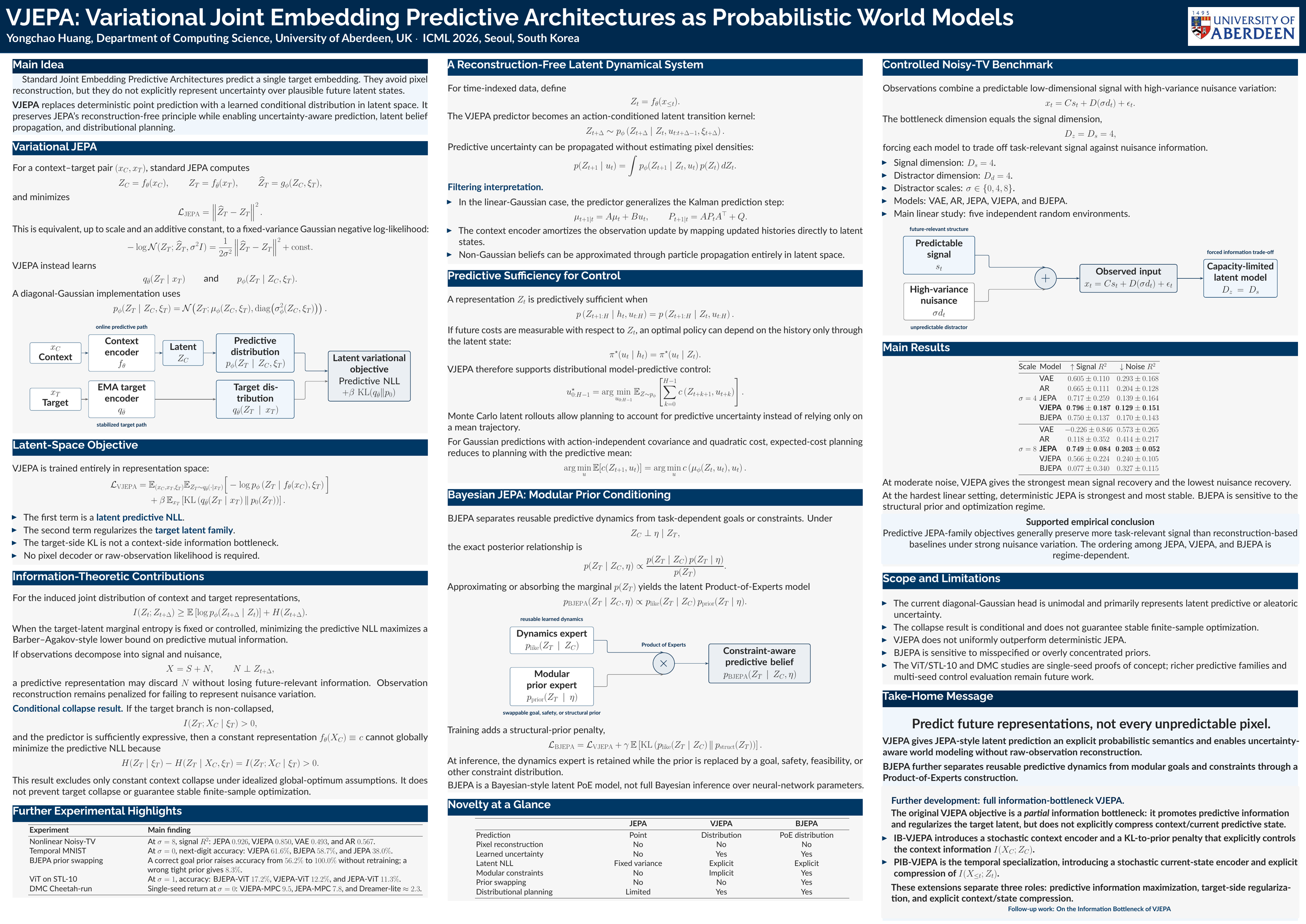
VJEPA argues that a time-indexed JEPA predictor should represent a conditional distribution over future latent states rather than a single target embedding. This makes uncertainty, belief propagation, and distributional planning explicit while retaining JEPA’s reconstruction-free objective.
A deterministic squared-error JEPA predictor is interpreted as an implicit fixed-variance isotropic Gaussian:
VJEPA replaces that point-prediction interface with learned target and predictive distributions:
and trains them with latent predictive negative log-likelihood plus target-side prior regularization:
For time-indexed data and explicit control inputs, the same predictor becomes a stochastic latent transition kernel:
This is the paper’s main bridge from JEPA representation learning to predictive state representations, Bayesian filtering, and stochastic model-predictive control without an observation decoder.
Bayesian JEPA Extension
Bayesian JEPA (BJEPA) separates a reusable learned dynamics expert from a swappable goal, safety, feasibility, physics, or structural-prior expert. Under the stated conditional-independence approximation, their product defines a constraint-aware predictive belief:
This is a latent Product-of-Experts construction, not full Bayesian inference over neural-network parameters. The empirical results also show that prior concentration and misspecification are first-order failure modes rather than implementation details.
Main Evidence
The strongest aggregate result in the ICML poster is the controlled linear Noisy-TV benchmark over five independent random environments. The bottleneck dimension equals the predictable signal dimension, forcing the model to trade off task-relevant signal against high-variance nuisance variation.
| Distractor scale | Model | Signal | Noise |
|---|---|---|---|
| VAE | |||
| AR | |||
| JEPA | |||
| VJEPA | |||
| BJEPA | |||
| VAE | |||
| AR | |||
| JEPA | |||
| VJEPA | |||
| BJEPA |
The supported empirical conclusion is regime-dependent:
- At moderate nuisance scale, VJEPA has the highest mean signal recovery and lowest mean nuisance recovery.
- At the hardest reported linear setting, deterministic JEPA is strongest and most stable.
- BJEPA is sensitive to its structural prior and optimization regime.
- Predictive JEPA-family objectives generally preserve more task-relevant signal than the reconstructive VAE and AR baselines under strong nuisance variation, but VJEPA does not uniformly dominate deterministic JEPA.
The later five-environment poster table is stronger evidence than the single Seed 111 table in arXiv v1. The arXiv run reports all JEPA-family models above signal at , whereas the poster’s aggregate result is materially weaker for VJEPA and especially BJEPA.
Further Poster Results
The poster reports additional proof-of-concept results:
| Experiment | Reported result |
|---|---|
| Nonlinear Noisy-TV | At , signal : JEPA , VJEPA , VAE , AR . |
| Temporal MNIST | At , next-digit accuracy: VJEPA , BJEPA , JEPA . |
| BJEPA prior swapping | A correct goal prior raises accuracy from to without retraining; a wrong tight prior gives . |
| ViT on STL-10 | At , accuracy: BJEPA-ViT , VJEPA-ViT , JEPA-ViT . |
| DMC Cheetah-run | Single-seed return at : VJEPA-MPC , JEPA-MPC , Dreamer-lite approximately . |
The poster explicitly classifies the ViT/STL-10 and DMC studies as single-seed proofs of concept. They should not be treated as mature representation-learning or control benchmarks.
Demonstrated Uncertainty Versus Multi-Modal Futures
This distinction is central for the wiki. The VJEPA interface can use mixture models, normalizing flows, or other expressive predictive families and can therefore represent several separated future modes in principle. The implementation evaluated in the paper and poster does not do that: both the target distribution and predictive head are independent diagonal Gaussians.
The demonstrated head is therefore unimodal and mainly represents latent predictive or aleatoric uncertainty. At a true bifurcation, such as mutually exclusive left-versus-right futures, one Gaussian can still place its mean between modes and assign probability to an invalid latent state. Multiple samples from one broad Gaussian are not evidence that the model has learned multiple separated modes.
For the knowledge base, the correct conclusion is:
VJEPA makes distributional latent prediction explicit, but calibrated multi-modal future modeling remains an architectural possibility and benchmark requirement, not a demonstrated result of the current implementation.
Theory And Boundary Conditions
- The paper connects time-indexed VJEPA to predictive state representations and latent Bayesian filtering.
- Its control-sufficiency result is conditional: if the learned latent state is predictively sufficient for all cost-relevant future consequences under candidate control inputs, an optimal policy can depend on that latent state instead of the full history.
- The collapse argument excludes constant context collapse only under target diversity, sufficient predictor expressivity, and idealized global-optimum assumptions.
- It does not guarantee stable finite-sample optimization, prevent target-branch collapse in every training regime, or prove preservation of task-relevant rather than merely predictable factors.
- The target-side KL regularizes the target latent family; it is not an explicit information bottleneck on the context/current predictive state. The poster identifies full information-bottleneck VJEPA as follow-up work.
Limitations And Gotchas
- The implemented predictive family is a unimodal diagonal Gaussian, not a demonstrated multi-modal distribution.
- Learned variance mainly addresses latent predictive or aleatoric uncertainty; epistemic uncertainty is not separately modeled or calibrated.
- VJEPA does not uniformly outperform deterministic JEPA in the five-environment linear benchmark.
- BJEPA can fail badly when its modular prior is misspecified or overly concentrated.
- The core evidence is dominated by low-dimensional synthetic Noisy-TV systems. STL-10 and DMC results are small, single-seed proofs of concept.
- No experiment tests multivariate numeric time series, irregular sampling, long horizons, rare regimes, event streams, exogenous variables, or typed operational interventions.
- The DMC result is not enough to establish robust stochastic control, calibrated risk-sensitive planning, or transfer to real systems.
- The official repository is minimal and had no clear open-source license in the verified snapshot.
Foundation TSFM Relevance
This work directly supports the local position that future time-series state should be a predictive belief, not only a point embedding. Its strongest contribution is the interface:
history + context + control inputs
  -> latent state belief
  -> distribution over plausible future latent states
-> risk-aware forecast, generation, or candidate-control evaluation| Agenda slot | Verdict | Evidence | Missing pieces |
|---|---|---|---|
| Latent-state prediction | partially closes | Outside numeric time series, formalizes time-indexed JEPA as a stochastic latent transition and predictive information state without observation reconstruction. | Needs real multivariate time-series state probes, long-horizon filtering, rare-regime preservation, and streaming updates. |
| Multi-modal future distributions | adjacent | Replaces a point latent prediction with an explicit conditional predictive distribution and Monte Carlo belief rollouts. | Current diagonal-Gaussian head is unimodal; needs mixtures, flows, diffusion, or another expressive family plus mode-coverage and calibration tests. |
| Control and counterfactuals | adjacent | Gives an action-conditioned latent-kernel formulation, stochastic MPC objective, Product-of-Experts prior conditioning, and a small DMC proof of concept. | Needs multi-seed closed-loop control, typed interventions, risk metrics, simulator-exploitation tests, and real numeric systems. |
| Anti-collapse regularization | adjacent | Gives a conditional information-mismatch argument against constant context collapse. | Needs finite-sample stability, target-collapse tests, non-Gaussian/long-tailed data, and probes for task-relevant rather than merely predictable state. |
| Context and constraints | adjacent | BJEPA can swap a goal or structural prior without retraining the dynamics expert. | Needs safeguards against misspecified or overconfident priors and a typed context/action schema. |
Relation To Nearby Sources
- Sundial samples passive future observations through flow matching; VJEPA instead makes the future latent state distribution explicit. A foundation time-series model likely needs both interfaces or a controllable bridge between them.
- Introduction to Latent Variable Energy-Based Models motivates latent variables for uncertainty and H-JEPA-style hierarchy; VJEPA supplies a concrete variational predictive objective but currently uses a unimodal Gaussian head.
- Energy-Based Transformers provides candidate scoring and iterative refinement, but its current many-mode failure shows that energy-based interfaces also do not guarantee separated future modes.
- World Models already used an MDN-RNN distribution over next latent state under actions; VJEPA reframes this distributional latent-state idea inside reconstruction-free JEPA learning and makes predictive sufficiency explicit.
Links Into The Wiki
- VJEPA
- Probabilistic JEPA Predictor Using Flow Matching
- Joint Embedding Predictive Architecture
- Latent-State Time-Series Modeling
- Foundation Time-Series Model Research Agenda
- World Models
- Energy-Based Models
- Latent-Space Predictive Learning
- Representation Collapse
- Distribution Priors In Self-Supervised Learning
- Contradictions And Open Tensions
Open Questions
- Which predictive family best preserves separated future regimes in latent space under a fixed training and serving budget: mixture density, flow matching, diffusion, normalizing flows, latent variables, or an energy-based model?
- How should a time-series model separate aleatoric uncertainty, epistemic uncertainty, regime ambiguity, and uncertainty caused by missing context?
- What benchmark can prove that sampled latent futures correspond to distinct valid trajectories rather than one broad averaged mode?
- How should latent-state calibration be checked when the latent coordinates are learned and not directly observable?
- Can modular priors encode goals, physics, or safety constraints without becoming overconfident and deleting plausible futures?
- Does reconstruction-free distributional latent prediction preserve the dense numeric detail needed for forecasting, generation, editing, and intervention evaluation?